Lipid membrane self-assembly and fusion
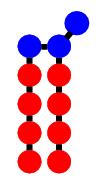
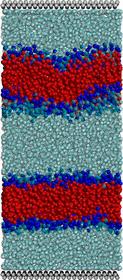
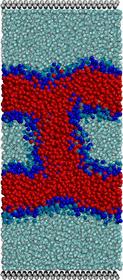
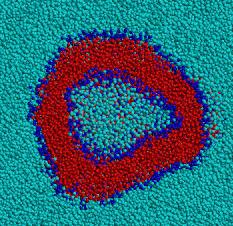
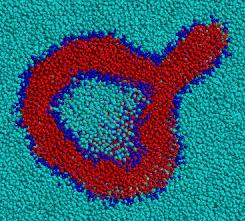
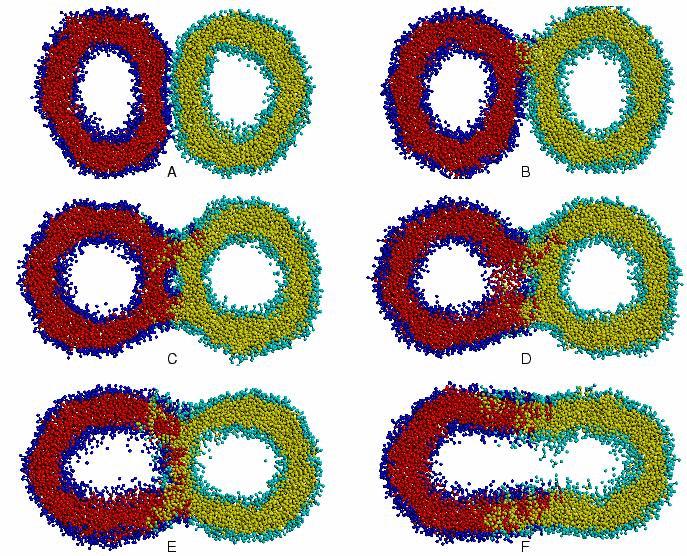
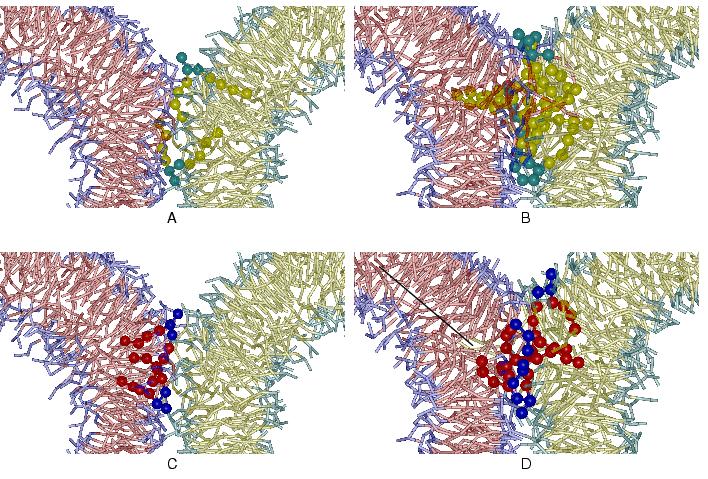
Work by Mark Stevens at Sandia on the self-assembly of lipid bilayers and membrane fusion using an idealized bead-spring model for a 2-tail lipid molecule.
Head-head and head-solvent interactions are set to give hydrophilic behavior; head-tail and tail-solvent interactions are hydrophobic. A 3d random ensemble of lipid molecules in a background solvent will spontaneously self-assemble into bilayers and vesicles, as shown by these 2d slice views. When two vesicles are gently pushed together they can fuse as tails of individual lipid molecules straddle both membranes. The detailed fusion images were made with VMD.
Related publications
- Insights into the molecular mechanism of membrane fusion from simulation: Evidence for the association of splayed tails, M. J. Stevens, J. H. Hoh, and T. B. Woolf, Phys. Rev. Lett. 91, 188102 (2003). doi:10.1103/PhysRevLett.91.188102