Electron force field for non-adiabatic dynamics
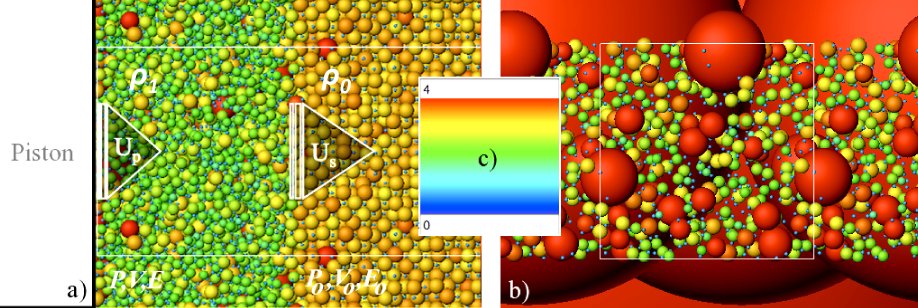

This is work by Andres Jaramillo-Botero and collaborators at Caltech to demonstrate the capabilities of their electron force field (eFF) implementation in LAMMPS for studying large-scale, non-adiabatic, explicit-electron dynamics of materials and systems under extreme conditions.
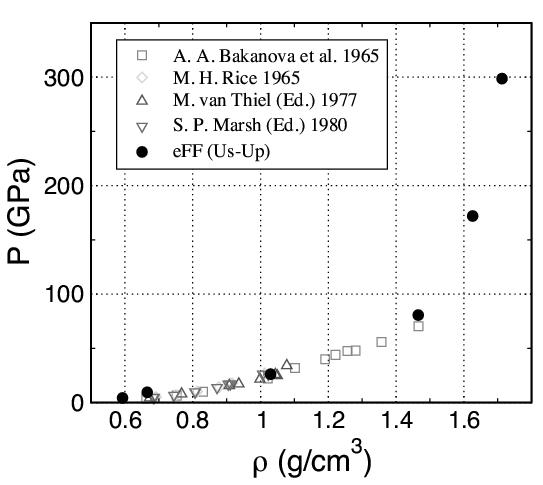
The first image shows the onset of lithium metal plasma formation immediately after a high-energy collision between a piston wall moving at 20 km/s and an fcc lithium crystal slab (close to a million particles). The shock wave front, moving from left to right at a velocity Us (higher than that of the piston, Up), is identified by the transition in material density (higher behind the shock front) and a clear phase transition, from the original fcc crystal structure to a compressed, highly amorphous state. Nuclei are represented by small blue dots of fixed size, while electrons are shown as lime-colored spheres. The coloring scheme used shows electrons transitioning from their stable orbitals (yellow grades), through higher energy states in the compressed region (green grades), up to delocalized (ionized) states with a higher positive total energy (shown via swollen red spheres, some of which are hidden by the periodic boundary representation). From the kinematics and dynamics of such simulations we are able to determine the material’s shock Hugoniot (see plot), as well as the necessary information to characterize the different phase states that appear along this particular path of the EOS, such as, fraction of ionized electrons as a function of impact speed to establish the onset of a plasma phase.
The movie shows an eFF simulation of the ionization process occurring when two lithium fcc crystal slabs collide at 20 km/s. The nuclei on each slab are color-coded points, while the electron floating spherical Gaussians are represented by translucent red and blue spheres corresponding to up and down spin, respectively (initially not perceptible, since they remain localized and with small kinetic energy near a nucleus). As the initial collision takes place the shock wave front propagates outward from the impact center, to form a warm dense plasma state with delocalized (swollen) electrons ‘floating’ around. Another phenomenon clearly observed on expansion is the formation of lithium dendrites.
Related publications
- Large-Scale, Long-Term Nonadiabatic Electron Molecular Dynamics for Describing Material Properties and Phenomena in Extreme Environments, A. Jaramillo-Botero, J. Su, A. Qi, and W. A. Goddard III, J. Comput. Chem. 32, 497 (2011). doi:10.1002/jcc.21637