Surface wetting by polymer nanodroplets
Work by Dave Heine (Corning), Gary Grest, and Ed Webb (Sandia).
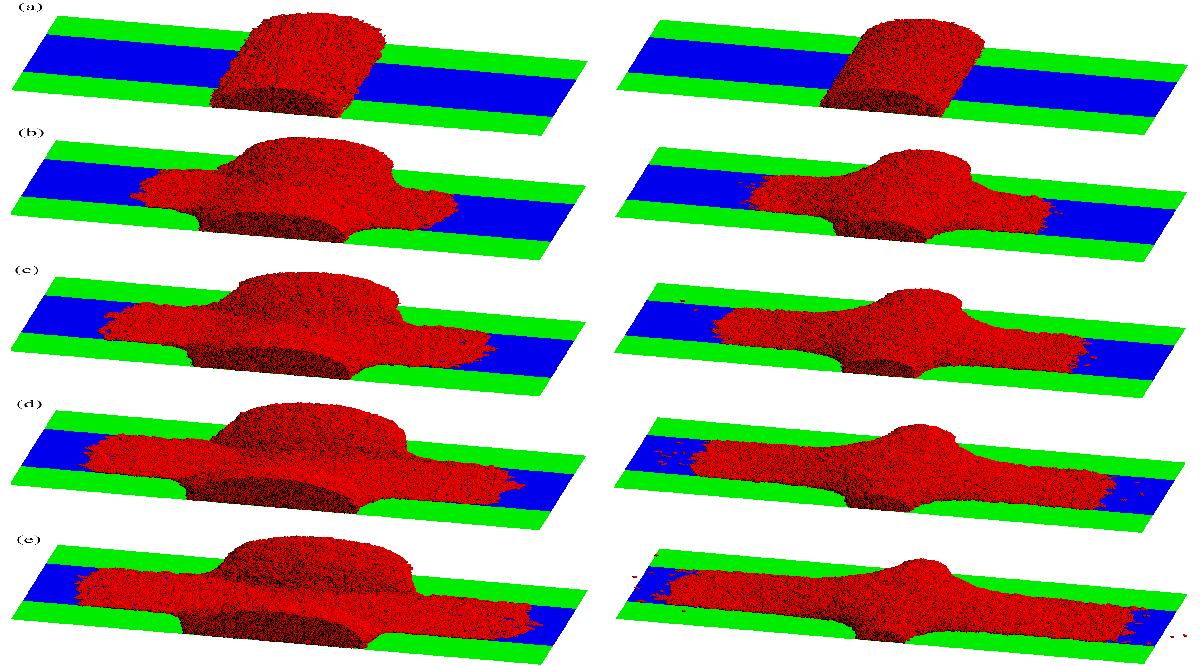
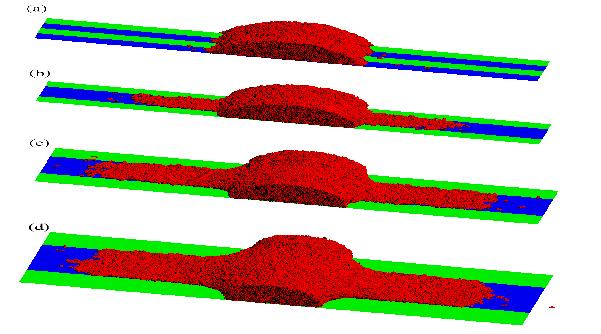
Bead-spring polymer chains are placed on a surface in a droplet form. The degree of wetting that results depends on various parameters, including the surface interaction strength and chain length.
The images show cuts through the droplet for different simulation conditions. The blue surface allows for more wetting than the green.
Related publications
- Diverse Spreading Behavior of Binary Polymer Nanodroplets, D. R. Heine, G. S. Grest, and E. B. Webb III, Langmuir 21, 7959 (2005). doi:10.1021/la050139t
- Liquid nanodroplets spreading on chemically patterned surfaces, G. S. Grest, D. R. Heine, and E. B. Webb III, Langmuir 22, 4745 (2006). doi:10.1021/la0531291
- Surface Wetting of Liquid Nanodroplets: Droplet Size Effects, D. R. Heine, G. S. Grest, and E. B. Webb III, Phys. Rev. Lett. 95, 107801 (2005). doi:10.1103/PhysRevLett.95.107801