Crazing of entangled polymer chains
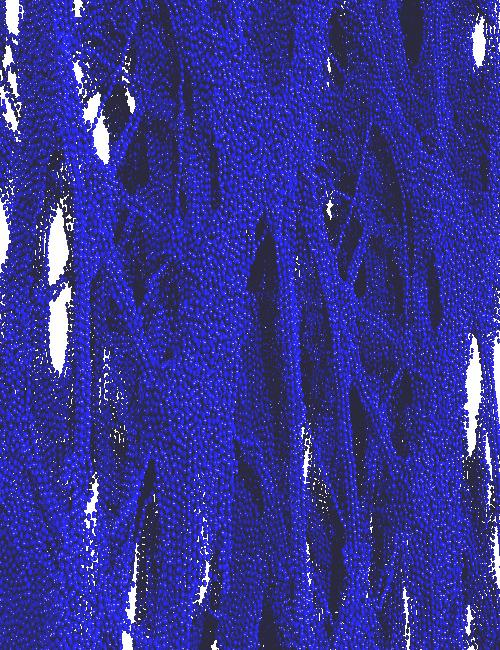
Work by Joerg Rottler and Mark Robbins at Johns Hopkins University. The image shows a polymer glass that has been deformed into a craze at large strains. In the craze, polymers (~0.5 nm diameter) are bundled into an intricate load-bearing network of ~10 nm diameter fibrils. Crazing is largely responsible for the high fracture energy of glassy polymers.
Related publications
- Growth, microstructure, and failure of crazes in glassy polymers, J. Rottler and M. O. Robbins, Phys. Rev. E 68, 011801 (2003). doi:10.1103/PhysRevE.68.011801
- Jamming under tension in polymer crazes, J. Rottler and M. O. Robbins, Phys. Rev. Lett. 89, 195501 (2002). doi:10.1103/PhysRevLett.89.195501
- Cracks and crazes: On calculating the macroscopic fracture energy of glassy polymers from molecular simulations, J. Rottler, S. Barsky, and M. O. Robbins, Phys. Rev. Lett. 89, 148304 (2002). doi:10.1103/PhysRevLett.89.148304